
This is my first time NOT to use an oven and “created” pastries–steam red bean bun 紅豆沙包.
Memory
Growing up in southern China, in which area people do not routinely eat flour-based food (麵食) such as noodles, steam buns, dumplings, I have never made any of the above, nor can I knit a dough, or make thin dumpling skins as my friends from norther China.
It is also uncommon for Chinese apartments to equip with oven, as pastry can be easily purchased at pastry at affordable prices and parents usually show their magics in dishes, home-made cuisines instead of in pastry and baking. In recent years, baking and pastry-making trend for both western baked goods and Asian baked goods is growing; small ovens could be purchased both online and in stores.
During COVID-19 quarantine in January and February 2020, cooking, baking wisdom are spurring back home in China. I saved sooo many recipes from Weibo and was amazed by how many chefs quarantine has trained. Now U.S. in quarantine and I am VERY happy to have enough reasons, and time to get back into cooking and baking!
Quick Takeaways:
- DO NOT use self-rising flour to substitute all-purpose flour
- Can add flavors to red bean paste with: brown sugar, cinnamon powder, sesame, crushed nuts
- Do not rise too long, not in too humid environment.
- Asian steam bun outer layer usually do NOT use oil, butter or shortening, so it might be healthier! The crust or filling for other Asian steam pastries might have oil/butter/shortening.
RECIPE
FINALLY!!! Today I want to share my first try on steamed red bean bun.
After watching a few YouTube video on red bean bun, I decided to go with this recipe for the outer bun layer:
- Portion: 11 buns
- All-purpose flour: 225g
- DO NOT substitute with self-rising flour, unless you could not buy any all-purpose flour during quarantine like me…will explain reasons later 🙂
- Active dry yeast: 3g
- Use NEW package if possible; if yeast package was open for a while, yeast might not be as active and will have hard time rising the dough/bun as well.
- Baking Powder 泡打粉: 3g
- Warm water (40C-50C): 120ml
- Put yeast in warm water to activate it. If temperature is too high, yeast could be killed and bun will NOT rise; if temperature is too low, it will take a looooong time to rise the buns.
- Sugar: 10g
- Sugar helps yeast
- Increase sweetness
Knitting Dough – Now it’s time to have some workout!
- After melting yeast in warm water, add them into dry ingredient in 2+ times and mix. At this time, it is normal that the dough is very wet and sticky.
- It is recommended to knit the dough with a straight arm: shoulder-armpit-wrist in one line 肩膀, 手臂, 手腕成一線, try not to bend. Use two arms to alternate and knit for 3-5 mins until the dough is smooth and not sticky anymore.
- Divide dough into 30-35 gram per piece.
- Cover in plastic wrap to avoid loss of moist.
- Also divide the filling of red bean paste into equal count of pieces.
Red Bean Paste:
I made my own red bean paste from scratch and will share in another post later! But overall it is a simple ingredient (red bean and sugar), simple process that takes some time.
This time I have added something that added unexpected yummy flavor to the filling — leftover filling of Korean Sweet Pancake (Hotteok | 호떡 | 糖餅)! It has brown sugar, cinnamon powder, white sesame and crushed nuts (peanuts) in it. My red bean paste was not very sweet and after adding this filling, the bun tastes JUST RIGHT/AWESOME/PERFECT/YUM!!!
So that is a surprise finding!
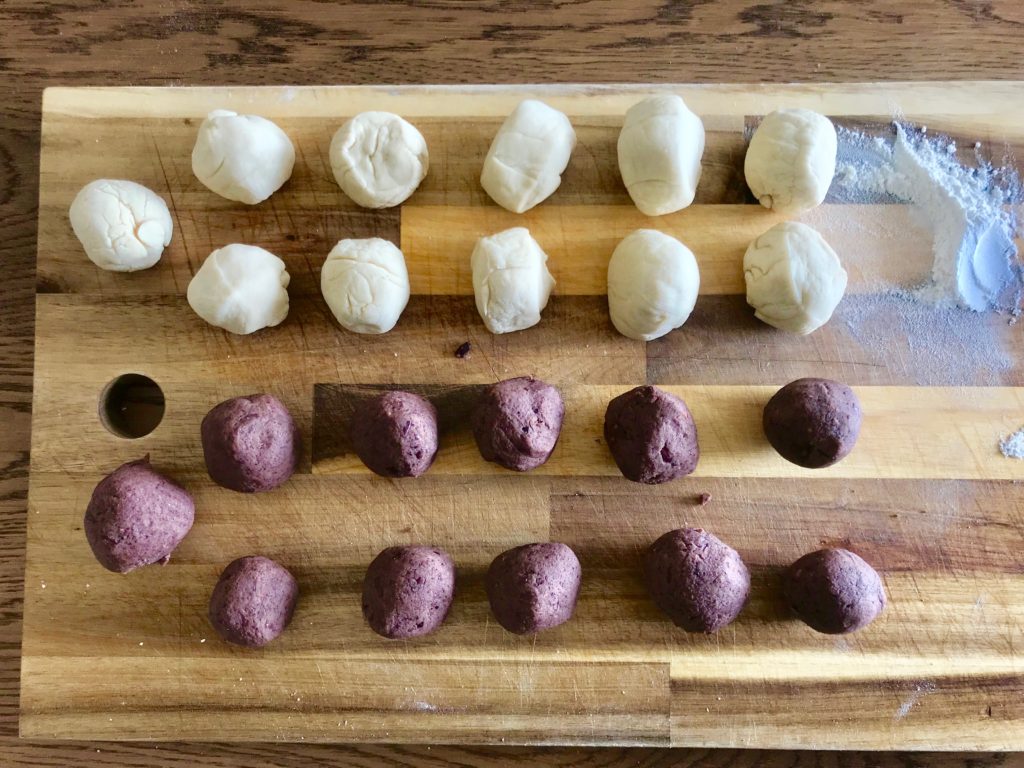
Experiment time!
I am a Biology nerd who loves doing control experiments. Today the experiment is to test out how bun skin/outer layer rolling will change bun texture.
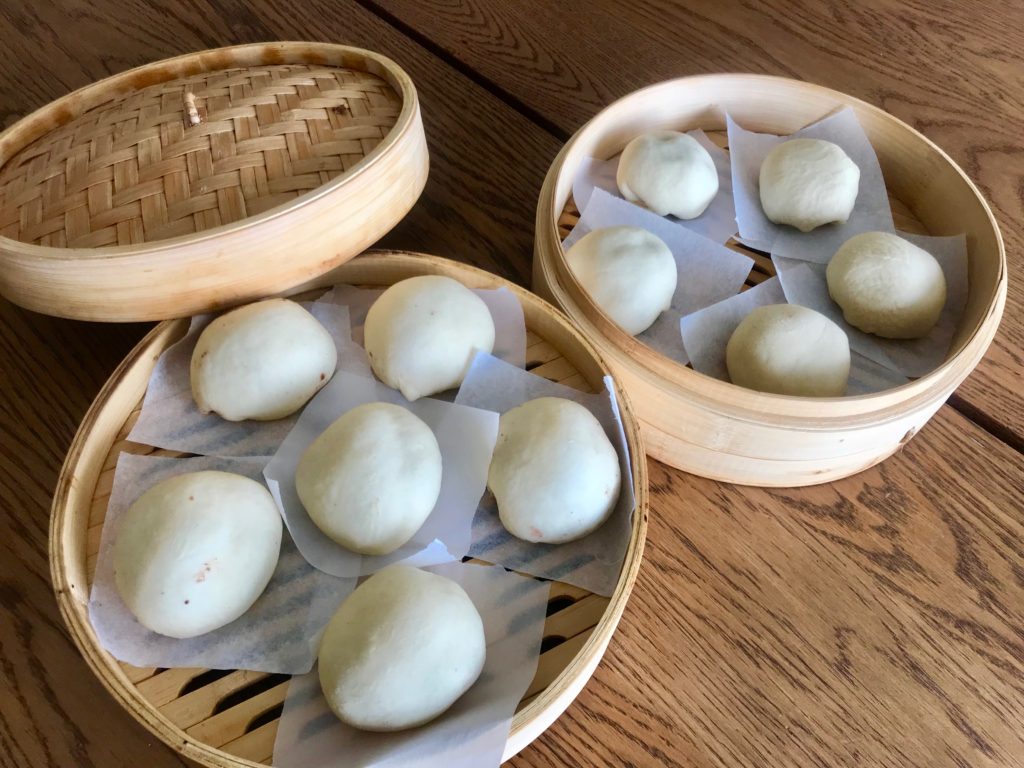
1st rolling is straight out rolling ball of dough into a flat round skin, wrap the filling in, DONE. (the left rack)
2nd rolling is to roll dough into rectangle/long shape, fold, rotate 90 degrees, roll, fold, rotate for 4-5 rounds, and finally roll out into a flat round skin, wrap the filling in, and DONE. (the right rack)
Hypothesis according to YT video is that more rolling, folding, will make the dough more smooth, which I can actually visualized here:
Dough/Bun Rising:
- Room temperature 21-25C
- Can put near stove, or in oven; place a pan with warm/hot water beneath to help rising in optimal temperature.
- Rising time: 20-30mins
- If in cold winter, might need as long as 2-3 hours of rising, could not be too long either, explain later 🙂
- Rising size: 1.5x original
- Sign of successful rising:
- LOOK: buns swell slightly with smoother surface
- SMELL: light aroma of liquor
- TOUCH: gently touch the edge and it is super soft and loose, as if there is air inside.
My report:
My dough did not rise as expected, but the multi-rolled buns (2nd method) rose more than the one-time-rolled buns (1st method) after 30mins. Their edges felt softer. Thus, I waited for another 5-6 hours, have place them near hot stove, placed hot water beneath, till the one-time-rolled buns also rose and became softer.
Steaming:
I have seen both ways of steaming:
- Boil water first, put buns on later for 15-20 mins.
- Put buns on when water is cold, steam for 15-20 mins AFTER water boil (so total steaming time is longer).
I have not tried the first one yet, but if I do in the future, I will come back for more updates!
When you are done, remember: DO NOT OPEN the lid right away. Wait 15-20 mins, otherwise the bun could collapsed (as I will demonstrated below 🙁 )
REVEAL TIME!!
1st method – rolled one time, less puffy
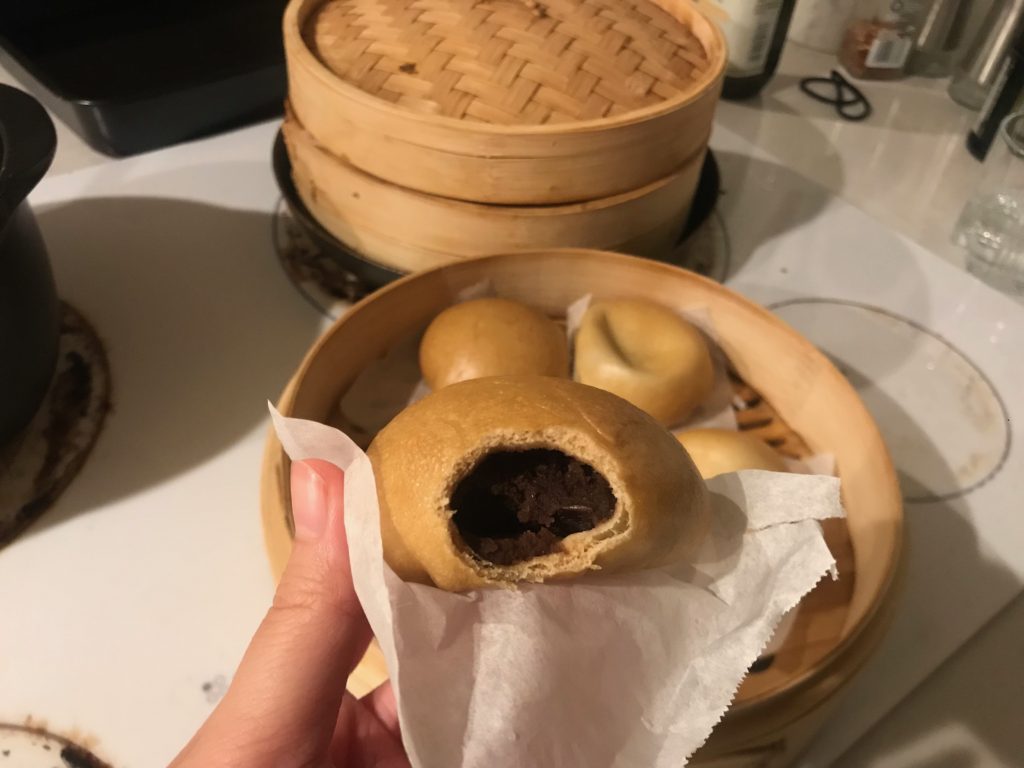
2nd method – rolled & folded 4-5 times, more layers and puffy
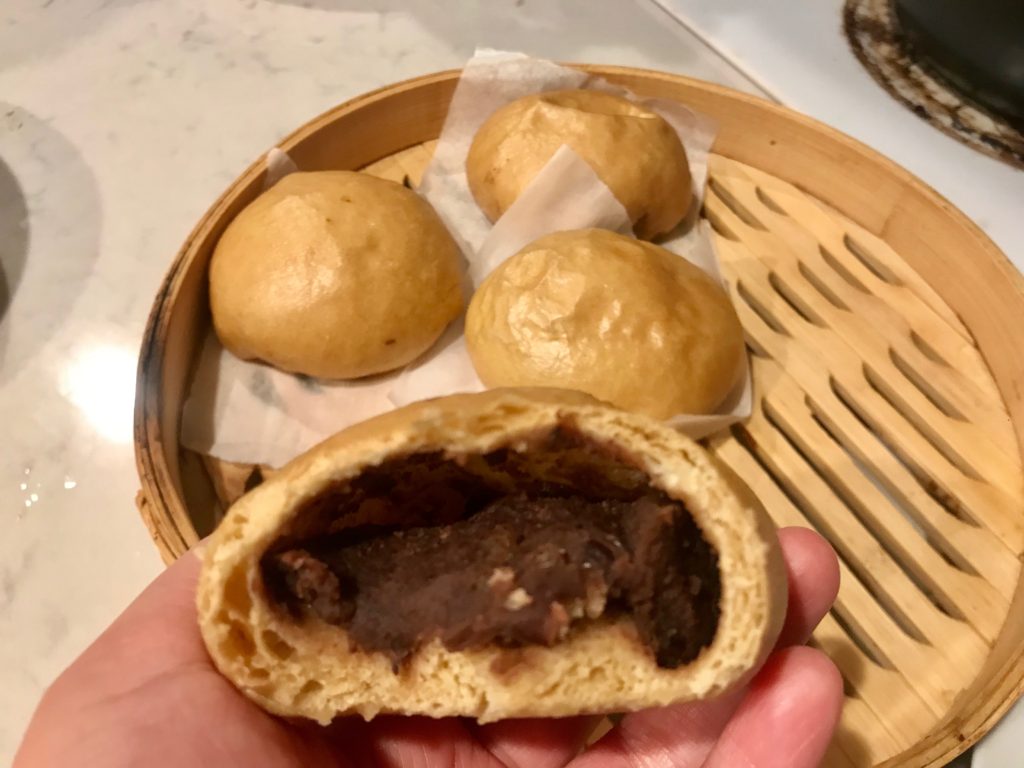
WHAT IS WITH THIS COLOR?? WHY NOT WHITE??
I was expecting puffy, soft, WHITE steam bun, but I was very surprised to find the yellow/burn looking buns when I lifted the lid 15 mins after I turned off the heat. Luckily, the buns taste very good! But the bun other layer was definitely NOT what I am looking for. After reading online articles, here are some failure reasons that I hope you and I can avoid in the future.
Reason 1: Self-rising flour and high pH/basic dough
I did not have enough all-purpose flour, and 4/5 of the flour was SELF-RISING FLOUR.
- Self-rising flour should NOT be used to substitute all-purpose flour (Spoon University), unless it’s for final touch-up or for fluffy pasty such as pancakes/ muffins/ biscuits.
- “It contains about 8.5% protein to develop less gluten than with all-purpose flour”. (myrecipes.com)
- It consists of baking powder, salt and all-purpose flour. Baking powder (泡打粉), baking soda (小苏打) are both basic with high pH. When using self-rising flour, the dough has MUCH MORE baking powder than needed. Basic dough can turn yellow when baking as basic pH can affect yeast.
Reason 2: Rising time too LONG
Even I was worried my bun did not rise enough, I still rose it for TOOOO long of 5-6 hours. Long rising time also lead to yellow bun.
Reason 3: Too much moist when rising
Ideal humidity for rising dough is 60-70%; if too humid/moist, oxygen will react with bun surface, oxidize and turn yellow when steamed. (包子创业交流平台(baozichuangye))
When I saw the buns were not rising, I panicked and put the racks on steam from boiling water for 2-3 mins. By the time I took them off steam, the surface was a bit wet.
Experiment report on rolling method
Back to our experiment: rolling one time versus rolling & folding 4~5 times.
Results:
- Layers:
- One-time-rolling buns have less layers, you can see from the first bitten bun picture
- Multi-rolling buns have more layers, more puffy as in the second bitten bun picture
- Biting/Chewing Texture:
- Personally I think the second one tastes much softer and bouncy, whereas the first one tastes more single layer, like the free cold bun you get from international flight. That’s right, domestic flight only gives you Biscoff or pretzels :p. I like Biscoff though~
Discussion & Summary (Nerd till the end like a paper)
Personally I like the multi-roll-and-fold method for bun skin. But I encourage you to try both and decide your personal favorite 🙂
Next time, I will NOT use self-rising flour to substitute all-purpose flour. (PLEASE let flour back in stock! PLEASE WEAR MASK and stay in, stay safe!)
I will also test out steam bun after water boil versus before water boil!